


Building Better Athletes Through Muay Thai
It’s About More Than Techniques
At NAK Martial Arts, we’re constantly asking ourselves one important question:
“What will best help our athletes succeed—not just in martial arts, but in life?”
Over the past 35+ years of martial arts training and coaching, and more than 10 years studying child development and youth coaching systems, I’ve learned something important:
Children don’t learn best through memorization alone.
They learn best through movement, problem-solving, confidence-building, positive coaching relationships, and learning how to adapt under pressure.
That’s why we’ve evolved our curriculum and belt system.
The Problem With Traditional Martial Arts
Many martial arts programs focus primarily on memorizing techniques.
Students learn:
- A punch
- A kick
- A combination
- Another combination
Then they perform those techniques during a test.
But real confidence and skill come from something deeper.
A child may know a combination perfectly but still struggle with:
✅ Balance
✅ Coordination
✅ Confidence
✅ Timing
✅ Focus
✅ Decision-Making
At NAK, we believe those qualities matter just as much as technique.
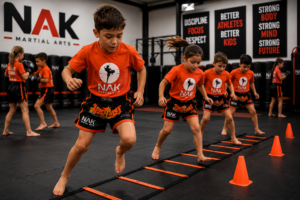
Refining Our Performance-Based Curriculum
One thing that hasn’t changed at NAK Martial Arts is our belief that athletes learn best through doing.
For years, our program has emphasized performance, application, and athlete development rather than simple memorization.
As we’ve continued to study child development, athlete development, and modern coaching methods, we’ve refined that philosophy even further.
Today, our curriculum places an even greater emphasis on developing the complete athlete.
Every season, athletes continue working on the core skills that lead to long-term success both on and off the mat:
🔥 Agility
Balance, footwork, movement, coordination, and body awareness.
🔥 Fundamentals
Punches, kicks, defense, posture, and proper mechanics.
🔥 Combinations
Connecting techniques together smoothly and efficiently.
🔥 Strength
Body control, conditioning, resilience, and physical confidence.
🔥 Speed
Reaction time, timing, explosiveness, and decision-making.
🔥 Sparring
Applying skills against a live partner in a safe and age-appropriate environment.
🔥 Clinch (Youth Muay Thai)
Control, balance, positioning, and close-range fighting skills.
Rather than viewing these areas as isolated skills, we view them as components of complete athlete development.
Our goal is not simply to teach athletes what to do.
Our goal is to help them develop the ability to perform, adapt, and succeed under pressure.
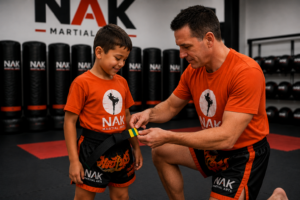
How Athletes Earn Stripes
One of the biggest changes families will notice is how athletes earn stripes.
Traditionally, stripes were often awarded during scheduled stripe testing sessions. While we will still have opportunities for athletes to make up missing stripes, our goal is to recognize achievement when it happens.
Instead of waiting for a testing day, coaches will increasingly award stripes during regular training sessions when an athlete consistently demonstrates the required skill, performance, effort, and understanding.
In other words:
Athletes won’t earn stripes because it’s testing week.
They’ll earn stripes because they’ve demonstrated they deserve them.
We believe this creates a more authentic learning environment where athletes are encouraged to improve every day rather than simply prepare for a test.
This approach also better reflects how real skill develops.
Athletes do not suddenly become more skilled on testing day. They improve gradually through consistent effort, practice, and performance over time.
Our coaches are observing those improvements every week.
By recognizing progress when it occurs, we can celebrate achievement in a way that is more meaningful, more motivating, and more closely connected to actual performance.
While our progression system has evolved, our standards remain high.
In fact, we believe this approach raises the standard by placing greater emphasis on consistent performance rather than a single testing day
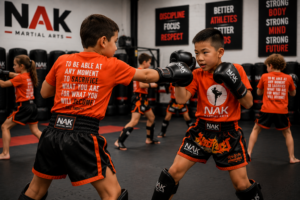 Why We Use More Live Training
One of the biggest influences on our curriculum comes from both modern athlete-development principles and child-development research.
Children learn best when they must:
- Think
- React
- Solve problems
- Make decisions
- Adapt
That doesn’t mean hard sparring.
It means age-appropriate drills where athletes learn how to apply skills against realistic challenges.
Instead of memorizing what to do…
They learn how to figure it out.
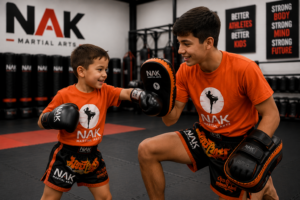
A Better Progression System
We’ve also redesigned the path between KIDZ Kickboxing and Youth Muay Thai.
KIDZ Kickboxing
Focuses on:
- Movement
- Balance
- Confidence
- Reactions
- Athletic development
Youth Muay Thai
Builds on that foundation with:
- Tactical thinking
- Advanced combinations
- Clinch work
- Sparring
- Adaptability under pressure
Athletes no longer feel like they are starting over.
Instead, each level prepares them for the next.
How Our Combination Progression Is Improving
At NAK Martial Arts, we are always working to make our curriculum clearer, stronger, and more meaningful for our athletes.
One change parents may notice is how we are using combinations in our ranking system.
The Old Way
In the past, each rank had its own combination.
That meant a White Belt might learn one combo, a Yellow Belt might learn a different combo, an Orange Belt might learn another combo, and so on.
Progress was often measured by the question:
“Did the athlete memorize the next combination?”
Memorization is useful, but it does not always show true skill.
An athlete could remember a longer combo but still struggle with balance, distance, movement, control, or timing.
The New Way
Now, athletes will work with the same seasonal combination, but the expectation changes based on their level.
Instead of asking, “Did they memorize a different combo?” we ask:
“Can they perform the combo at a higher level?”
This means the combination becomes a teaching tool.
The sequence may be the same, but what we are looking for becomes more advanced as the athlete grows.
Example
A beginner may perform:
Jab → Cross → Rear Kick
At that level, we are looking for:
- Good stance
- Balance
- Correct order
- Hands returning to guard
- Basic control
An intermediate athlete may perform the same combo:
Jab → Cross → Rear Kick
But now we may add:
Jab → Cross → Rear Kick → L-Step
At that level, we are looking for:
- Movement after the attack
- Better distance
- Better footwork
- Cleaner reset
An advanced athlete may still use that same combo:
Jab → Cross → Rear Kick
But now the expectation may become:
Jab → Cross → Rear Kick → Pivot Exit or Circle Off
At that level, we are looking for:
- Better positioning
- Reading partner movement
- Faster rhythm
- Finishing in a safer or stronger position
The combo is familiar.
The performance standard is higher.
Why This Is Better
This helps athletes develop real skill instead of simply collecting more techniques.
The old model was:
New rank = new combo to memorize
The new model is:
New rank = better performance, better movement, better understanding
This makes progression more honest and more athletic.
It also helps parents understand what improvement really looks like. Your child may be practicing a familiar combination, but they are not doing the same work. They are being asked to perform it with more balance, more control, more movement, more timing, and more decision-making.
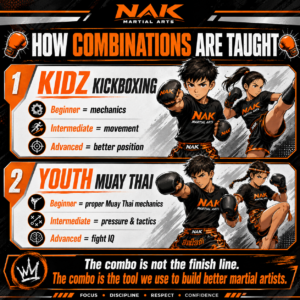
KIDZ Kickboxing
In KIDZ Kickboxing, the progression looks like this:
Beginner: Can they do the combo correctly?
Intermediate: Can they move after the combo?
Advanced: Can they create a better position after the combo?
The same seasonal combination can now grow with the athlete.
Youth Muay Thai
In Youth Muay Thai, the progression goes even deeper.
Beginner: Can they perform it with proper Muay Thai mechanics?
Intermediate: Can they use movement, pressure, and position?
Advanced: Can they use the combo to set up a tactical finish?
That may include things like clinch entry, knees, elbows, sweeps, counters, or exiting when nothing is available.
The Big Change
Before, combinations were treated like separate rank requirements.
Now, combinations are treated like vehicles for development.
That means the belt is not just a sign that an athlete memorized the next sequence.
It shows that the athlete can perform with a higher level of skill.
Better balance.
Better movement.
Better timing.
Better decision-making.
Better martial arts.
That is the direction of NAK Martial Arts.
What Hasn’t Changed
While our curriculum has evolved, our mission has not.
We still teach authentic Muay Thai.
We still believe rank should be earned.
We still emphasize:
- Respect
- Discipline
- Focus
- Leadership
- Character
And we still believe parents and coaches working together can help children become the best version of themselves.
Better Athletes. Better Kids. Better Future.
At NAK Martial Arts, our goal isn’t simply to create better martial artists.
Our goal is to develop confident, resilient young athletes who are prepared to succeed in sports, school, leadership, and life.
Thank you for trusting us with your child’s development.
— Coach Dave